

Every day, more companies announce ambitious climate commitments. Some aim to become Carbon Neutral. Others commit to achieving Net Zero. Many invest in carbon credits, explore carbon removals, or develop long-term decarbonization strategies.
At the same time, customers, investors, regulators, and business partners are asking organizations to demonstrate real progress, not just ambitious promises. With so many terms being used, it's easy to lose sight of the bigger picture.
So where should a business actually begin?
The answer is surprisingly simple.
Not with carbon credits. Not with offsets. Not even with Net Zero.
Every successful decarbonization journey starts with understanding one thing: Where are your emissions coming from?
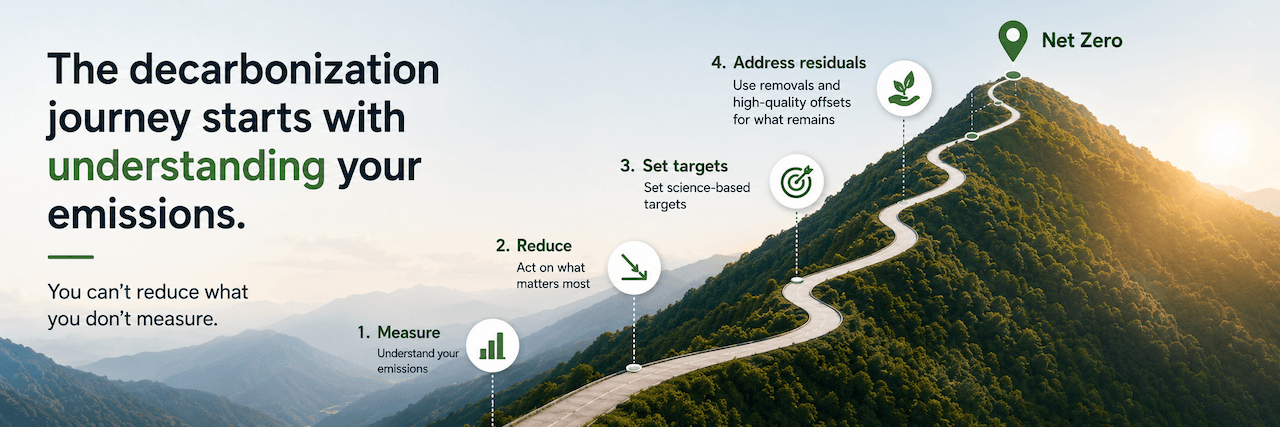
Decarbonization starts with measurement
Decarbonization is the process of reducing greenhouse gas emissions over time. Before a company can reduce emissions, however, it first needs to understand them.
That's why the first step is developing a Corporate Carbon Footprint.
Using internationally recognized methodologies such as the GHG Protocol Corporate Standard, organizations calculate emissions generated by their operations and value chain. These emissions are grouped into Scope 1, Scope 2, and Scope 3, providing a structured picture of where greenhouse gases are generated.
For many organizations, this exercise is eye-opening.
The biggest sources of emissions are often not where they were expected. Manufacturers may discover that purchased materials contribute more than energy consumption. Service companies often find that purchased goods and services or business travel dominate their footprint.
Without measuring emissions first, companies are effectively making climate decisions without knowing where the greatest opportunities for improvement exist.
From carbon footprints to decarbonization
Measuring emissions is not the goal. It's the starting point.
Once emissions have been quantified, businesses can identify their largest emission hotspots and focus their efforts where they will have the greatest impact. Depending on the organization, that might involve:
- Improving energy efficiency
- Redesigning products
- Selecting lower-carbon materials
- Optimizing transportation
- Working with suppliers
- Increasing the use of renewable electricity
Every organization will have different priorities. The important point is that real decarbonization comes from reducing emissions, not simply compensating for them.
This is also where many climate-related terms begin to appear.
Carbon Neutral, Net Zero, and Zero Emissions are not the same thing
These terms are often used in the same conversation, but they describe different climate ambitions.
Carbon Neutral
Carbon Neutral generally means balancing greenhouse gas emissions by purchasing carbon credits that support projects reducing, avoiding, or removing emissions elsewhere. It can play a role in climate strategies, but it doesn't necessarily require companies to significantly reduce their own emissions before using offsets.
Net Zero
Net Zero goes much further. Under the Science Based Targets initiative (SBTi), companies first make deep emissions reductions across their operations and value chain. Only residual emissions that cannot realistically be eliminated are neutralized with eligible carbon removals.
Zero Emissions
Zero Emissions is the most ambitious outcome: no greenhouse gases are emitted. For most businesses and products, that is extremely difficult across an entire lifecycle. Claims often refer only to a specific stage, such as the use phase of an electric vehicle.
Reduce first. Neutralize only what remains.
Understanding these distinctions helps businesses communicate their climate ambitions more accurately and develop strategies that align with internationally recognized frameworks.
Carbon removals, carbon credits, and carbon offsets: how do they fit together?
Another area of confusion is the relationship between carbon removals, carbon credits, and carbon offsets. Although they're closely connected, they describe different concepts.
Carbon removals are activities that remove carbon dioxide from the atmosphere and store it over the long term. Examples include reforestation, biochar, and Direct Air Capture.
Some carbon removal projects generate carbon credits, which are tradable certificates representing one metric tonne of CO₂e that has been reduced, avoided, or removed. Carbon credits may also be generated by projects that avoid or reduce emissions, such as renewable energy installations.
A carbon offset is the use of those carbon credits to compensate for a company's own emissions.
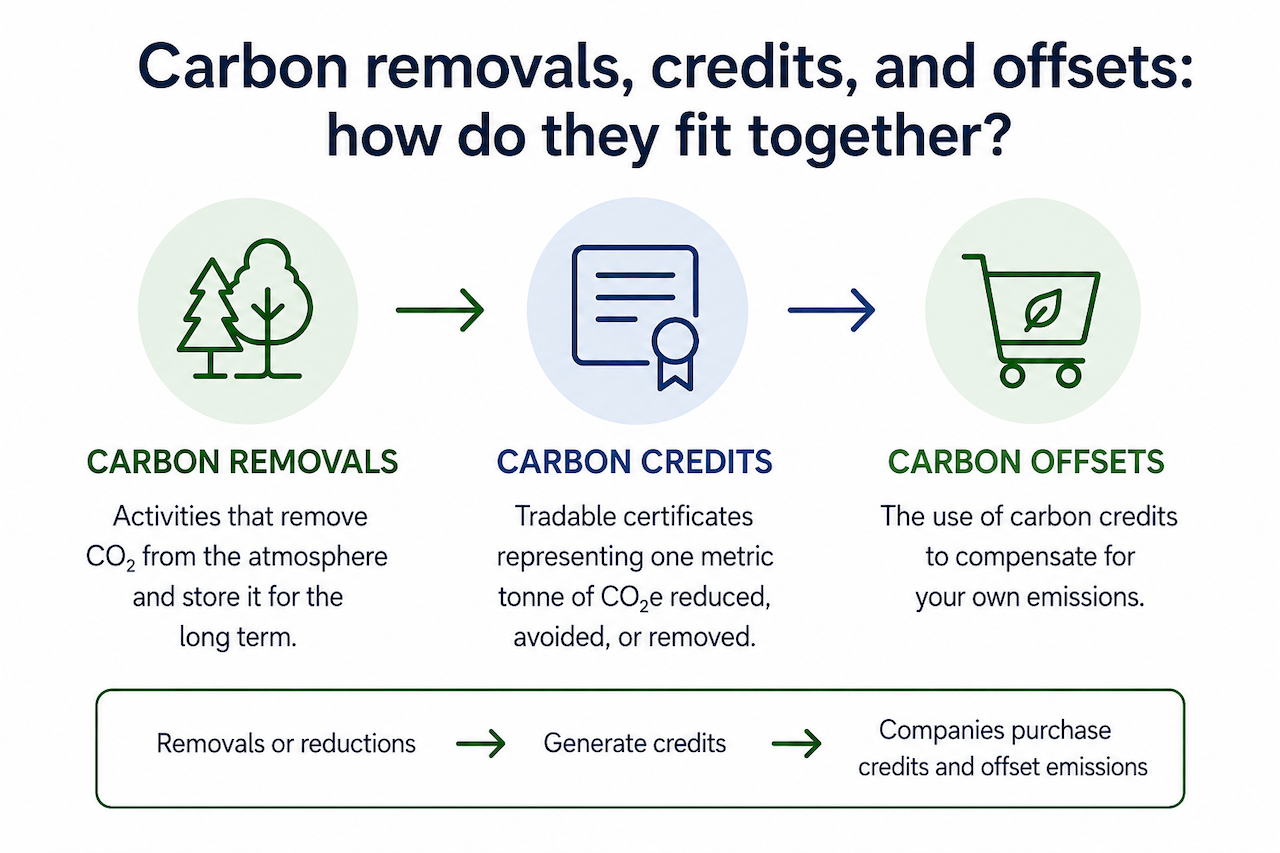
In short:
Carbon removals take CO₂ from the atmosphere. Carbon credits are certificates generated by reduction, avoidance, or removal projects. Offsetting happens when a company uses those credits to compensate for its own emissions.
While these mechanisms have an important role to play, leading climate frameworks increasingly emphasize that they should complement—not replace—direct emission reductions.
What does SBTi expect from companies?
The Science Based Targets initiative has become one of the most widely recognized frameworks for corporate climate action. Its guidance is based on a straightforward principle: companies should reduce emissions as much as possible before relying on carbon removals.
Under the currently operative Corporate Net-Zero Standard, long-term targets generally require companies to cut emissions by more than 90%. Only the residual emissions that cannot be eliminated are neutralized through permanent carbon removal and storage.
Standards update: SBTi published Corporate Net-Zero Standard V2.0 in June 2026, with an effective date of February 1, 2027. It retains the reduction-first architecture: companies pursuing Net Zero must reduce Scope 1, 2, and 3 emissions to zero or residual levels and neutralize all residual emissions with eligible carbon removals.
This reflects a broader shift in corporate sustainability. Climate leadership is no longer measured by the number of carbon credits purchased, but by how effectively organizations reduce emissions within their own operations and supply chains.
A successful decarbonization journey follows a clear path
Although every business is different, the overall journey is remarkably similar:
- Measure emissions
- Identify emission hotspots
- Reduce emissions
- Track progress
- Set credible climate targets
- Address only the remaining residual emissions where appropriate
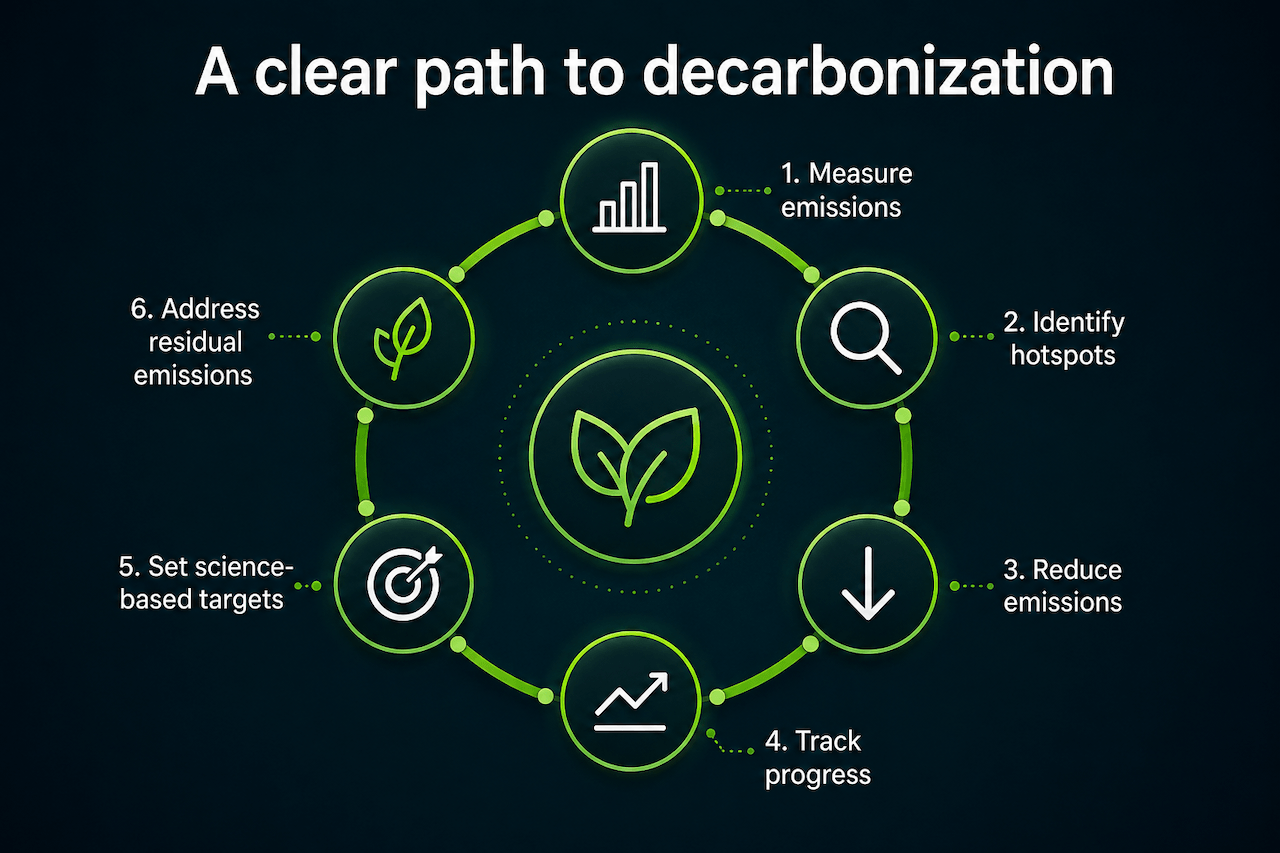
Companies that follow this sequence build climate strategies that are both credible and resilient. Those that skip the first steps often struggle to demonstrate meaningful progress.
Decarbonization starts with data
Every climate target, every reduction initiative, and every sustainability report begins with reliable data. Without understanding where emissions originate, it's impossible to prioritize reduction opportunities, measure progress, or communicate climate performance with confidence.
At Verde365, we help organizations turn sustainability data into meaningful action. Our platform supports companies throughout their decarbonization journey: from calculating Scope 1, 2, and 3 emissions, to identifying hotspots, tracking progress, and generating audit-ready sustainability reports.
Because before reducing, offsetting, or removing emissions, you first need to understand them.
Final thoughts
Decarbonization isn't a single project or a certificate that can be achieved overnight. It's a continuous process of understanding emissions, taking meaningful action to reduce them, and measuring progress over time.
Whether your organization is just beginning its sustainability journey or working toward ambitious climate goals, the most important step is always the first one: building a clear understanding of where your emissions come from. From there, every decision—from reducing emissions to setting science-based targets—becomes more informed, more effective, and more credible.
Ready to understand your emissions?
Build a clear Scope 1, 2, and 3 baseline with Verde365, identify the hotspots that matter, and turn reliable data into a credible reduction plan.